For those curious about Upper Peninsula history, the answer to a question about a hometown, family name or long-forgotten community may be just a few clicks away.
UPLINK, the Upper Peninsula Digital Network, brings digitized historical materials from across the Upper Peninsula together in one searchable database. The collection includes newspapers, photographs, correspondence, mining records, oral histories, diaries and other materials from historical societies, libraries, museums and archives throughout the region.
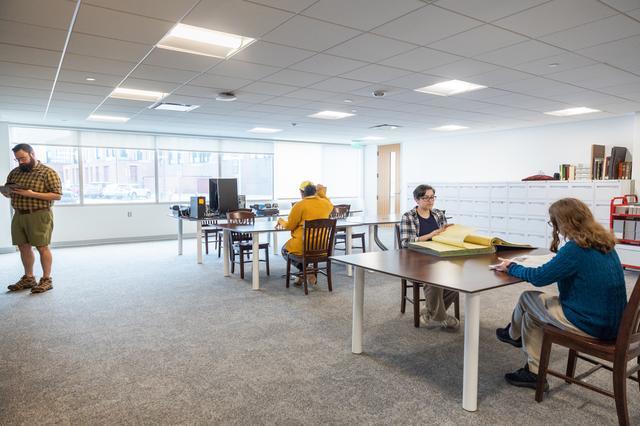
At Northern Michigan University, the project is part of the work of the University Archives, which preserves materials documenting the history of the university and the Upper Peninsula.
For Annika Peterson, the position also brought her back to a familiar place. She attended NMU from 2013 to 2017, earning degrees in history and mathematics, and worked in the University Archives as a student.
After graduating, she pursued a master's degree in history before deciding to focus on archival work. She later earned a master's degree in library science with a focus on archives, preparing her for a career preserving and providing access to historical materials.
In 2021, an opening for a digital project manager with UPLINK brought her back to Northern. She has remained at NMU since, eventually stepping into the university archivist role after the retirement of longtime NMU Archivist Marcus Robyns.
Peterson said one of the things she appreciates about working in a smaller university archive is the variety of responsibilities, from managing collections to supporting classroom instruction and helping students explore careers.
Today, Peterson oversees UPLINK as part of her work with the University Archives. She said the network provides researchers with access to materials that once would have required visits to multiple historical organizations across the region in archival work.
“It does give you sort of a one-stop database where you can look across places all over the U.P.,” Peterson said.
UPLINK currently includes collections from more than 30 organizations across the Upper Peninsula, including historical societies, libraries, archives and museums. The network allows participating organizations to make their collections available digitally while giving researchers a single place to search across them.
The convenience of digital access is only one benefit.
Digitizing historical materials can also help protect fragile originals from unnecessary handling. Once a document, photograph or map has been digitized, researchers can access the digital version without needing to repeatedly handle the original.
Digital collections can also make new types of research possible.
Peterson pointed to newspapers as one example. Researchers working with newspapers on microfilm traditionally have to move through pages individually. Digitized newspapers, however, can be searched by keyword, allowing researchers to examine decades of coverage much more efficiently.
The collections also extend beyond the traditional records people might expect to find in an archive.
UPLINK includes personal materials such as diaries, family papers and correspondence. Some collections contain World War II letters between husbands and wives, while others document experiences at tuberculosis sanitariums. Oral histories provide another way for individual stories from across the Upper Peninsula to be preserved and accessed.
For people researching their own family history, those collections can offer a connection to the past.
“Most people with roots in the U.P. could probably find something about their family in UPLINK,” Peterson said, while noting that some geographic areas have fewer materials available than others.
The network can also be useful for people who simply want to learn more about where they live.
Peterson encouraged curious users to start by searching for a family surname or the name of a town. Students and employees at NMU can also use UPLINK to explore the history of the university, their departments or other aspects of campus.
“It’s not just meant for quote-unquote serious researchers,” Peterson said. “It’s meant for just people who are curious to learn more about their town or their family, whatever the case might be.”
UPLINK began in 2021 as a grant-funded project and has continued with primary support from NMU and contributions from member organizations. As the network grows, new collections continue to be added.
Current projects include preparing newspapers from Dickinson County for digitization, including materials from Iron Mountain and Norway, as well as additional newspapers and yearbooks from Manistique. The Negaunee Historical Society is also contributing scrapbooks containing photographs and materials related to local mines, schools, sports teams and ski jumping competitions.
Expanding the collection requires more than simply scanning documents. Each item must be described and organized so researchers can find it. Materials also need to be consistently tagged and categorized across collections.
Digital preservation itself also requires ongoing work.
“Digital records are just as fragile, maybe more fragile than the physical records,” Peterson said.
Maintaining digital history requires regular backups, checking those backups, maintaining the website and ensuring that materials remain accessible. Those efforts require time, staff and funding.
Community members can also play a role in expanding and improving the collection. UPLINK accepts community donations of historical materials, although not every item can necessarily be added to the database. People can also provide information about materials already online, such as identifying a person in a photograph or providing evidence that an item's description may be incorrect.
For Peterson, the network represents more than a digital collection. The collaboration between historical organizations across the Upper Peninsula has also created opportunities for those groups to communicate, share resources and work together.
“I think that in general, history, oral history, especially, is a way to kind of build community and connect people,” Peterson said.
Whether searching for a family name, investigating a hometown or simply wondering what life looked like in the Upper Peninsula generations ago, the stories are already there. They may just be waiting to be found. For anyone interested in exploring that history, UPLINK offers a place to start.
To donate to this organization, click here.