
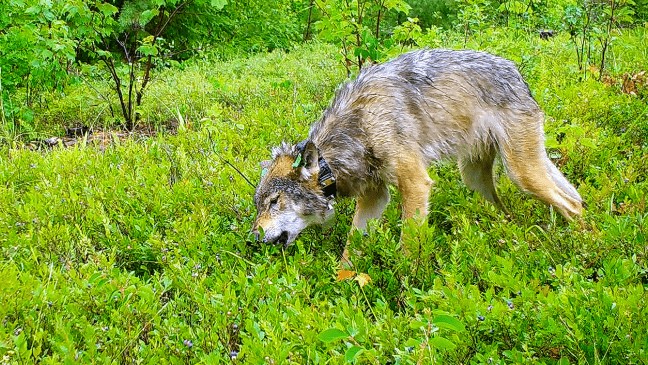
After GPS clusters light up the map at the Voyageurs Wolf Project housing site in Minnesota, technician Alex Gross, a Northern Michigan Biology graduate student, arrives at the coordinates wondering what evidence the wolves might have left.
Some days, it’s a few small remnants of a deer fawn or beaver left after a hunt, or perhaps he is taking a trek out to the mouth of a den where pups are sleeping; but in the middle of a hot Minnesota summer, those coordinates often lead him to a foraged patch of wild blueberries.
Gross, in collaboration with VWP, recently published research on the impact wolves have on wild blueberry growth in northern Minnesota.
Co-lead author of the study, Gross is one student in a continued collaboration between NMU’s Biology department and alumnus Thomas Gable’s ’16 MS organization, Voyageurs Wolf Project, which works to track predation behaviors of wolves out of Voyageurs National Park.
The research, published by Royal Society Publishing, found that blueberry seeds germinate faster and with a higher success rate after being digested by wolves than they do on their own. While primarily carnivores, wild blueberries make up a large portion of a wolf's diet during the summer months.
“This highlights an underappreciated role of wolves and connects them to larger ecological processes in boreal ecosystems that are often overlooked,” Gross said. “It's cool to see people's interest in that – to know people are interested in the impact wolves have on other ecological processes, and this project gets at that.”
Gross spent much of his time in the field investigating the blueberry patches where wolves were grazing. VWP uses GPS devices to track the wolves' location, allowing researchers to note where wolves are congregating and stopping. Researchers will go to those sites after the wolves have left the area to investigate the land and understand what the wolves were doing in that location.
While Gross began his work with Voyageurs in 2024, the research on wolves' relationship with blueberries began back in 2017. The organization had collected samples and begun gathering data already, but had yet to analyze and publish its findings. When Gross joined the team, he saw that as an opportunity to turn these findings into a published article.
Gable said Gross’ work over the summer was “impressive.”
“I was able to observe how he approached collecting data in the field. I was impressed not only with his abilities to do the work at a high level but also by his keen interest in predation and ecology overall,” Gable said. “Given his work ethic, abilities and drive, I was happy to provide him that opportunity, as I was almost certain he would be successful. And he obviously was.”
Getting published is “a long process and a tough process,” Gross said. The paper is much more than collecting and analyzing data to form a conclusion, but, for a student, it’s also learning the style and going through peer review and editorial processes.
“Going through the process of preparing something with the intention of getting that published I think was really helpful... coming here with that experience made me feel a lot more comfortable,” he added.
Gross is one of a number of students who have worked with Voyageurs and received their masters in Biology at NMU, studying under fellow VWP collaborator, Professor John Bruggink.
“The NMU-VWP connection has been great in large part because Dr. John Bruggink in the Biology Department has been a great continued collaborator,” Gable said. “Further, Northern Michigan University is able to support graduate students working on our project by providing them graduate assistantships, while our project is able to provide all of the field and logistical support for the research students are doing in northern Minnesota. So the partnership has been a win-win for our project and NMU.”
Read the MPR story on their research to learn more.