Northern Michigan University biology student Lars Anderson spent the summer conducting undergraduate research at the University of California, Davis, investigating how persistent aquatic pollutants affect fish development and behavior.
Working with researchers in the Whitehead Lab, Anderson studied Atlantic killifish and their responses to noncoplanar polychlorinated biphenyls, or ncPCBs, a class of industrial pollutants commonly found in estuaries along the eastern United States.
The research examined why killifish continue to thrive in some of North America's most heavily contaminated estuaries despite the potentially harmful effects of these chemicals. Researchers suspect that populations exposed to ncPCBs over generations may have evolved resistance to their effects.
“I was interested in this work because I like behavior, but also because I’m interested in the underlying mechanisms of evolution,” Anderson said.
PCBs were once widely used in electrical equipment and building materials before the United States banned their production in 1979 because of concerns about their effects on human health and the environment. However, the chemicals persist in the environment and continue to accumulate in fish and other wildlife.
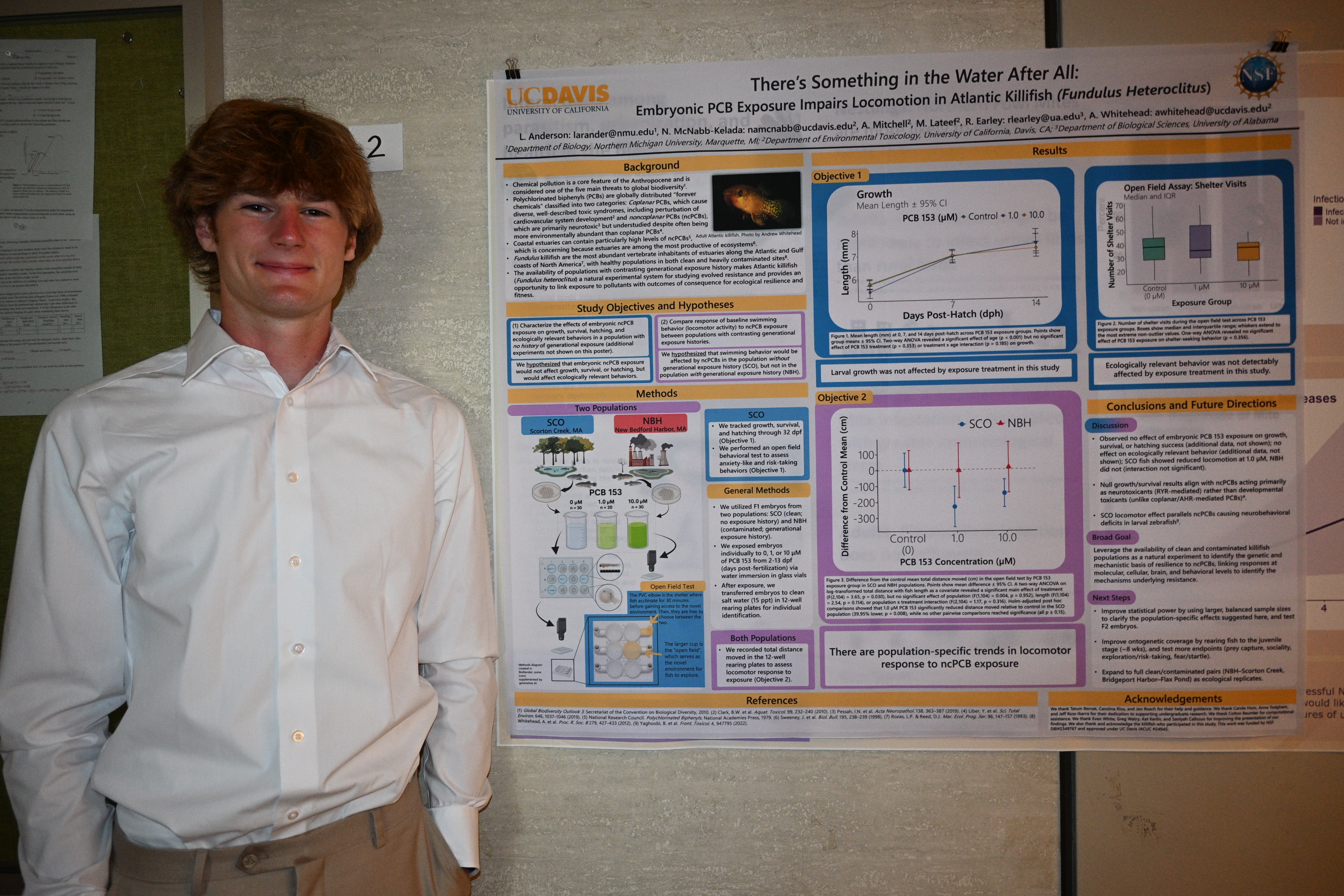
Anderson’s role involved exposing killifish from urban and nonurban populations to the chemicals and conducting behavioral tests to determine whether exposure affected their movement. Comparing the populations allowed researchers to investigate whether fish with generations of exposure responded differently than those without a history of exposure.
The work required a combination of preparation, laboratory experiments and data analysis. Anderson spent several weeks reading scientific papers and planning experiments, including coordinating where the fish would be kept and how researchers would track them. During the experiments, he brought fish into a specialized room where their behavior was recorded. He then analyzed the data and prepared a research poster.
One unexpected challenge was coordinating the research around the needs of living organisms.
“The fish are living their lives on their own schedule, spawning when they want, and growing up so fast,” Anderson said.
Each stage of the experiments also affected the next, requiring researchers to plan months ahead of time.
For Anderson, one of the most memorable moments came when he analyzed the data he had collected throughout the summer. After creating his first graph, he saw that the two fish populations responded differently to the chemical exposure.
“There was so much hope, angst, and anticipation ahead of getting some results, so when I made the first graph from data I’d collected, the whole summer’s work came to a head at once,” Anderson said.
The results provided a starting point for further investigation into how killifish populations may respond differently to long-term environmental contamination. Researchers hope future work will help explain whether resistance has evolved and identify the genetic and molecular mechanisms behind it.
Beyond the scientific findings, Anderson said the experience provided opportunities to develop skills that would have been difficult to gain in a traditional classroom. Working alongside other researchers allowed him to receive individual mentorship while learning through hands-on experience. He also discovered the value of making mistakes as part of the research process.
“I got lots of one-on-one mentorship from my lab mates, which allowed me to slow down and speed up at my own pace when learning new things,” Anderson said. “Additionally, I was able to get my hands dirty and make mistakes, which made things stick a lot better.”
The variety of daily tasks made the experience both challenging and rewarding, Anderson said. Each day presented a new problem to solve, from planning experiments to interpreting results. He hopes other students recognize the value of undergraduate research as an opportunity to build confidence and gain practical experience before pursuing careers in science.
“Having the opportunity to practice research as an undergrad in low-stakes settings gives young scientists confidence and training that more than pay back the mistakes made along the way,” Anderson said.
He cited NMU Biology Professor Jill Leonard specifically as a driving force behind his enthusiasm for work.
“Dr. Leonard was instrumental in both supporting my application and fostering a love of science, especially fish,” he said.
Through his summer at UC Davis, Anderson gained experience in experimental planning, behavioral testing and data analysis while contributing to research into how wildlife responds to pollutants that remain in the environment decades after their use was banned.