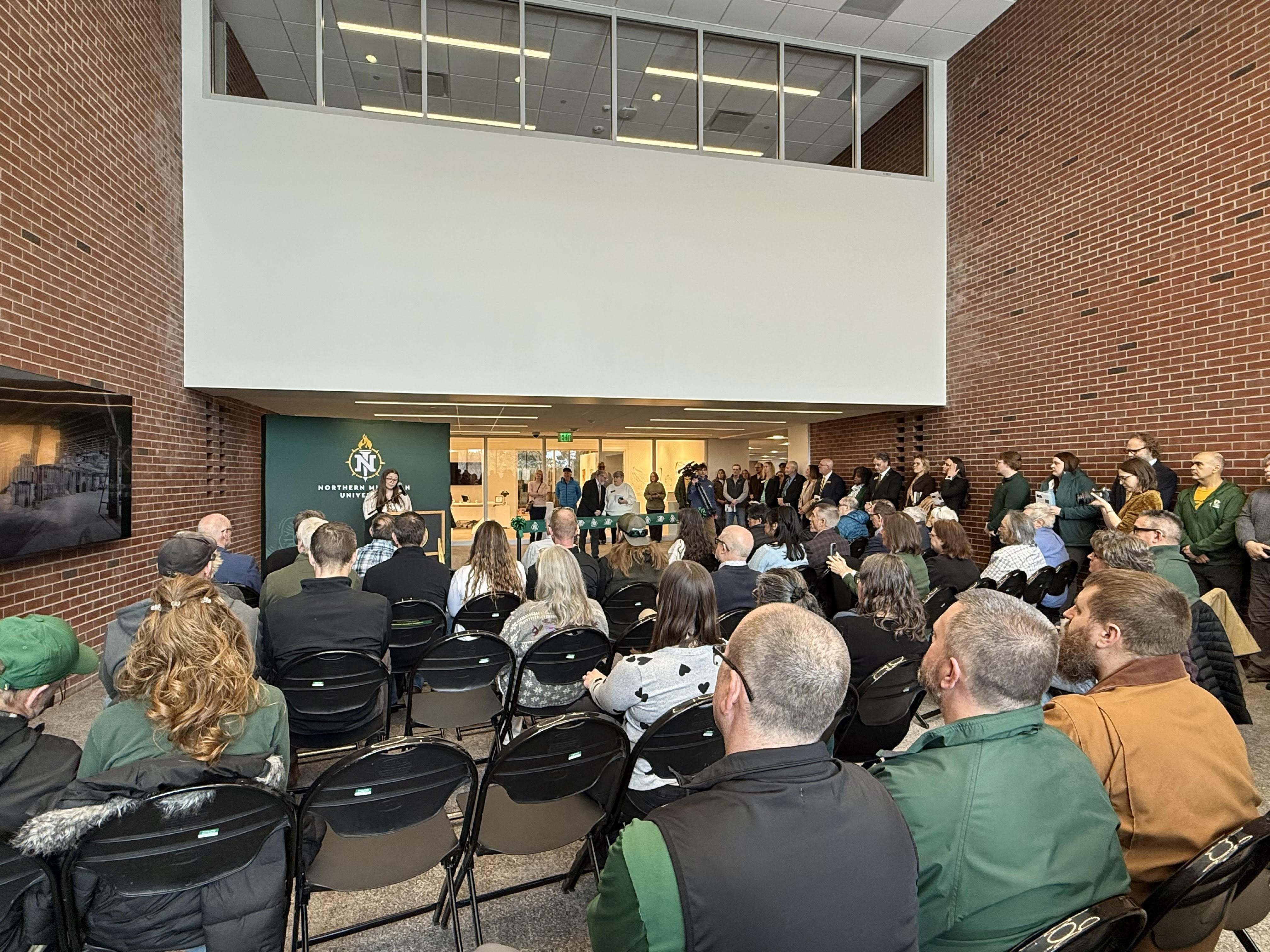
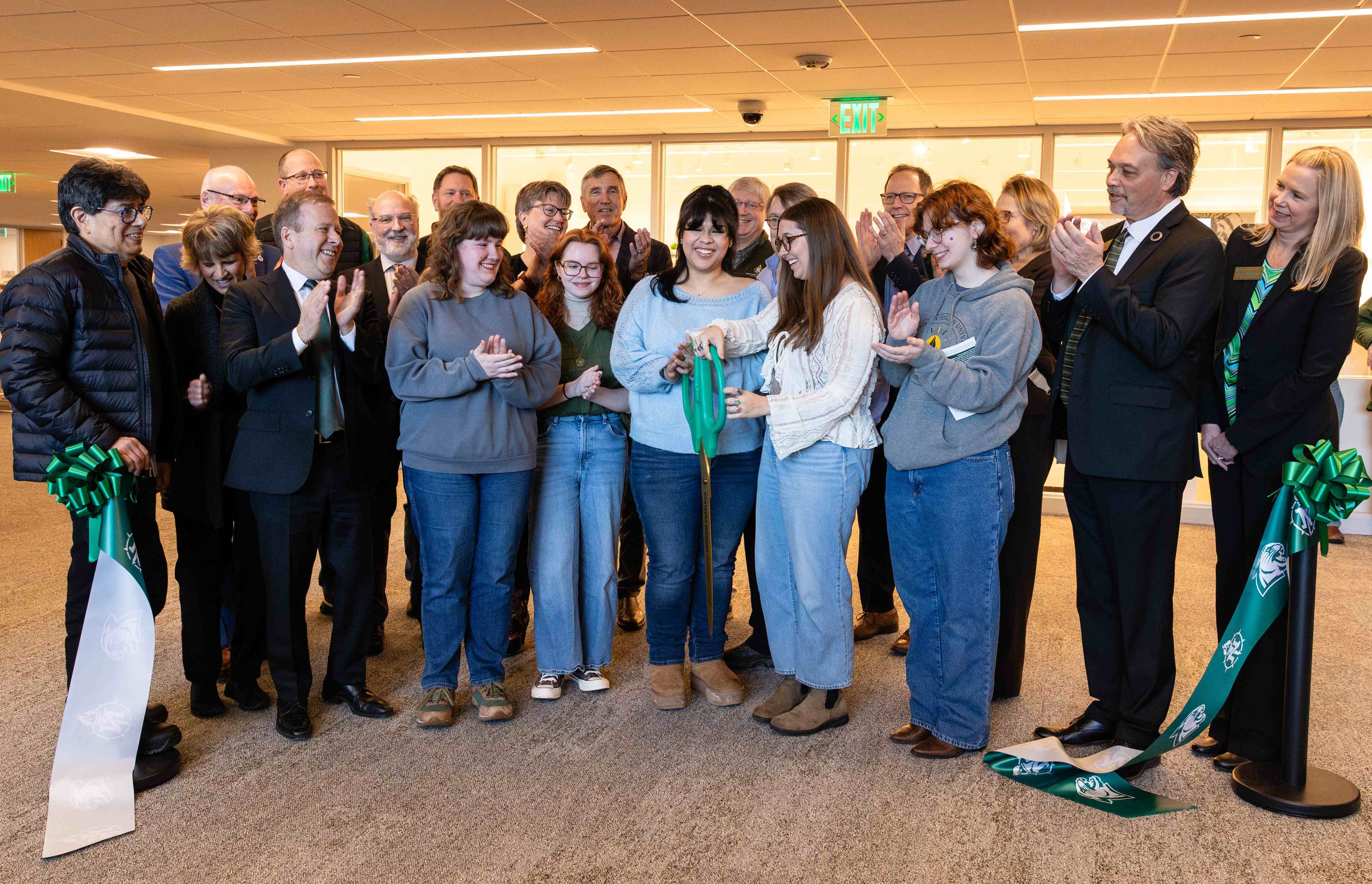
Northern Michigan University held a Feb. 13 rededication ceremony and ribbon cutting to celebrate the completion of Phase I renovations to the upper floors of Harden Hall.
The facility first opened in 1969, after former President Edgar L. Harden recommended that Northern build a new library to accommodate its fast-growing enrollment. The former Learning Resources Center, commonly called the LRC, was named in his honor.
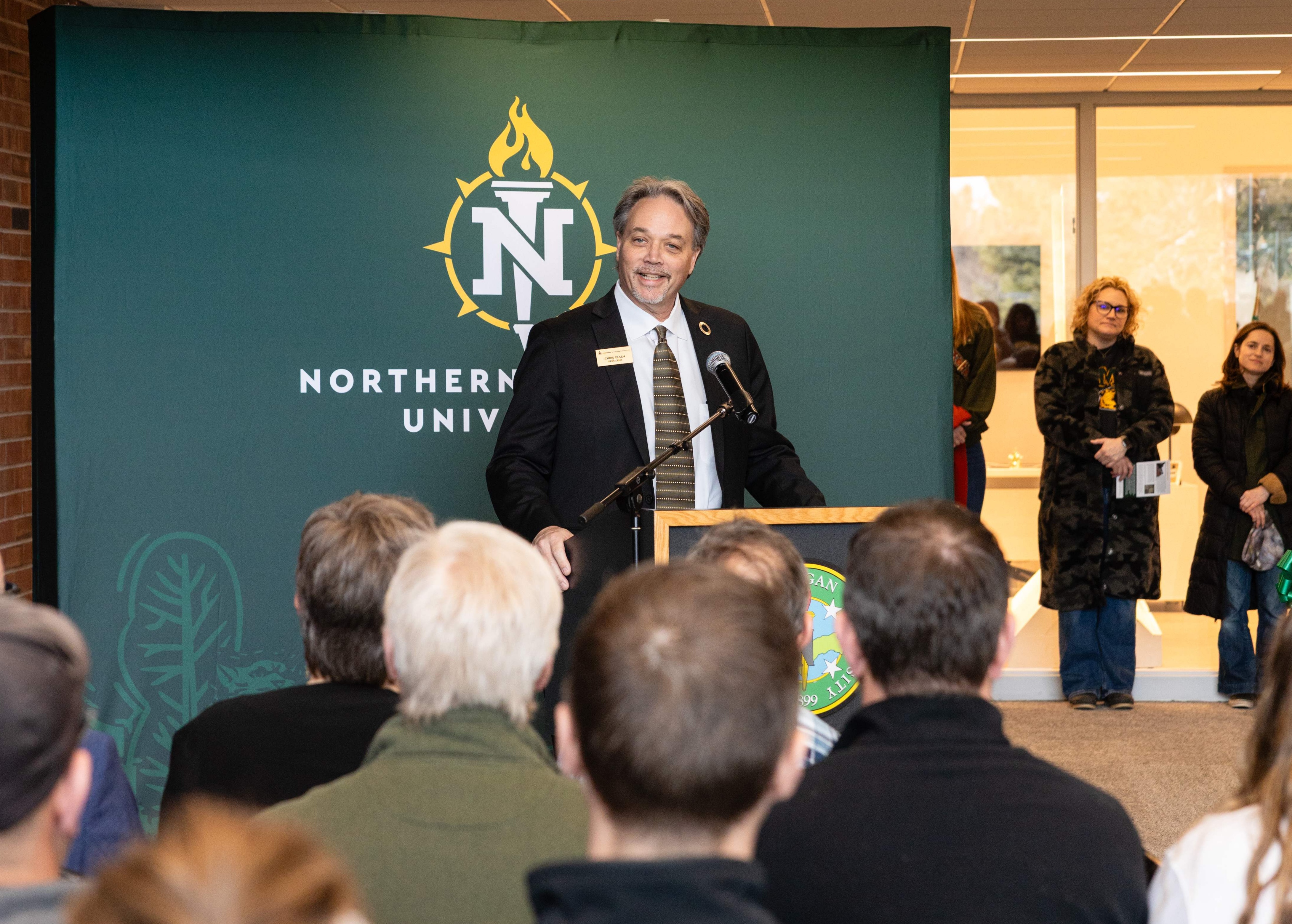
“I was reading President Harden's vision of bringing a wide array of learning resources together under one roof, and I would say he was very much ahead of his time in terms of university planning and thoughtfulness about the many ways a university can support students," said NMU President Chris Olsen. "That is reflected in this building. It's a wonderful facility and serves as a real hub for campus and students. All benefit when the library's packed with people using the space and resources in the best way possible. The end result is terrific. Special thanks to Gavin Leach, whose leadership was critical in getting us to this point.”
Harden Hall's renovation refreshes Olson Library's blend of study areas, services, technology and resources, with an emphasis on student learning and belonging. The biggest change is the addition of the Learning Commons, a space that includes all four campus tutoring centers. When no active tutoring is taking place, the area is open for students to study or hang out.
“I personally have a strong relationship with this facility,” said NMU Board Chair and alumna Missie Holmquist. “I was a commuter student who spent many, many hours here studying in between classes. The quiet comfort of the LRC was the perfect safe haven. While on-campus students had their rooms or apartments as their primary energy space, commuter students like me treated what we called the LRC as our second home. I speak for the board when I say that we are so pleased with how well this renovation turned out, and we thank all of those involved.”
A new partial fourth floor was built to house departmental offices for Economics, History, Philosophy and Political Science. Another major difference is that several campus entities are now co-located together. These include the Central U.P./NMU Archives and Beaumier U.P. Heritage Center, along with the Honors Program, SISU Innovation Institute, and SHINE (Sustainability Hub for Innovation and Environment).
Other additions include: the Holocaust collection reading room, which features rotating materials from Olson Library's extensive collection of more than 8,000 titles related to the Holocaust and other genocides; a podcast recording room; a one-touch recording space for class projects, rehearsing a speech and other purposes; and accessible computer setups.
The atrium is reservable and equipped with furniture that can be moved around in flexible configurations. There are also new spaces that can be reserved for events or meetings.
Leslie Warren, dean of Library and Instructional Support, wore a bracelet to the rededication that used to belong to the late Roberta “Bobbie” Henderson, who served as a reference librarian and instructor from 1971-1993 and has a classroom named in her honor.
“It was people like Bobbie and our other retirees who actually started the major evolution of libraries as we changed to electronic, and as we shifted to be community centers,” Warren said. “Libraries have evolved a lot from the time when this building was built to where we are now in terms of print materials. Many of our resources are online now, so about half of our print collection—roughly 125,000 volumes—is upstairs, with another 125,000 in remote storage and requestable via our website.”
Beaumier Center Director Dan Truckey said Alden B. Dow, who studied for a summer with Frank Lloyd Wright at Taliesin in Wisconsin and opened his own design firm in Midland, Mich., was the architect for the original Learning Resources Center.
“He's considered one of the greatest architects of the mid-century, modern movement period in the country, and is the only one to be named the Michigan architect laureate,” Truckey added. “When you walk around this building, you see that the front has changed a great deal, but the back side still looks the way it did originally when it was designed. We have to thank both Alden and Dr. Harden for making this a reality.”
The nearly two-year, $32.7 million Harden Hall renovation began in spring 2024. Leach said Phase II, scheduled to get underway in May after the current semester ends, will transform the lower level of the facility into a student union-style space. During that time, impacted offices and services, with the exception of Public Radio 90 and WNMU-TV, will be relocated to Gries Hall. The project is scheduled for completion in February 2027.